Major Temple Complexes
Luxor · East Bank
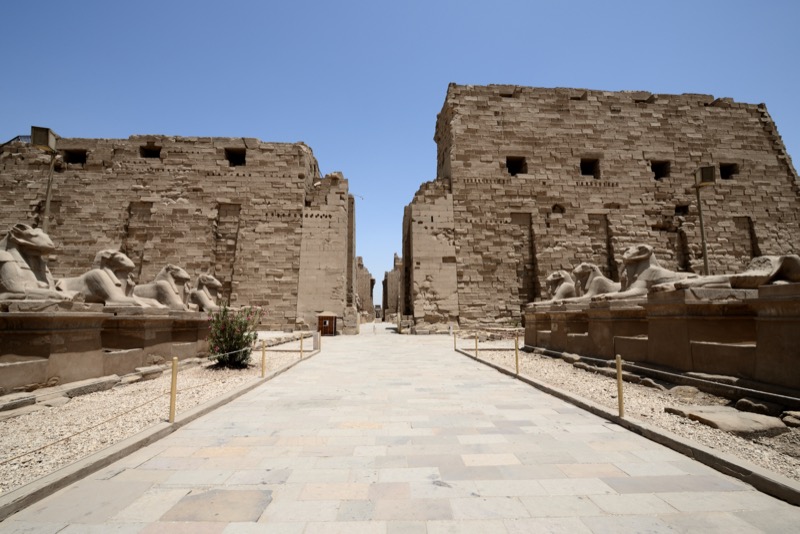
Karnak Temple Complex
Covering 247 acres, Karnak is the largest religious building ever constructed and the most architecturally complex site in Egypt. The Precinct of Amun-Re — the main accessible area — includes the Great Hypostyle Hall (134 columns, 23 metres high), the Sacred Lake, the Open Air Museum, and the Festival Temple of Thutmose III. The Precinct of Mut to the south contains a horseshoe-shaped sacred lake and over 700 seated Sekhmet statues; it is accessed on a separate ticket but is rarely visited and invariably uncrowded.
Construction at Karnak began under Senusret I around 1950 BCE and continued through the Ptolemaic period, making the site an architectural biography of ancient Egyptian civilisation. The layered contributions of successive pharaohs are visible at almost every point — obelisks erected by Hatshepsut later enclosed in a masonry screen by Thutmose III, a courtyard expanded by Ramesses II over an earlier festival hall, Ptolemaic gateways added to New Kingdom enclosure walls. Following the evolution of the site teaches more about Egyptian political and religious history than most textbooks.
Current access: open 06:00–17:30 in winter, 06:00–18:00 in summer. Standard ticket EGP 450 (April 2026). Open Air Museum included. Festival Temple of Thutmose III requires an additional EGP 100. Sound and Light show schedule varies; English performances typically run Wednesday and Saturday evenings. See also our comprehensive Luxor Guide.
Luxor · East Bank
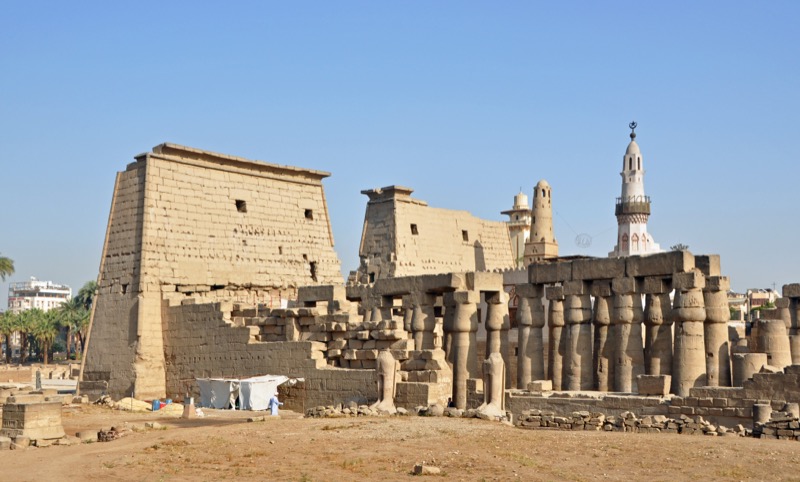
Luxor Temple
Standing at the centre of modern Luxor, this temple was built primarily under Amenhotep III (c. 1390 BCE) and expanded significantly under Ramesses II, who added the first pylon, the peristyle court, and two colossal seated statues of himself. One of the original pair of obelisks from the Luxor pylon now stands in the Place de la Concorde in Paris, shipped to France in 1833. The remaining obelisk reaches 25 metres and retains a gilded cap added by Ramesses.
The temple interior includes three significant additions from later periods: a Roman shrine to Emperor Alexander Severus painted over pharaonic reliefs in the 3rd century CE, the mosque of Abu Haggag built into the northeast corner and still in active use, and extensive Coptic Christian painting fragments in the hypostyle hall. These overlapping layers from different civilisations in a single structure are one of Luxor Temple's most distinctive characteristics.
The Avenue of Sphinxes connecting Luxor Temple to Karnak — fully excavated and opened in 2021 — runs 2.7 kilometres through the modern town. Walking the full avenue requires tickets at both temples; the most scenic stretch passes the Temple of Amenhotep III colonnade visible through the east wall. Evening illuminations begin at sunset and transform the first pylon into one of Egypt's most photographed night scenes. Ticket: EGP 350. See also: Luxor comprehensive guide.
Aswan · Lake Nasser
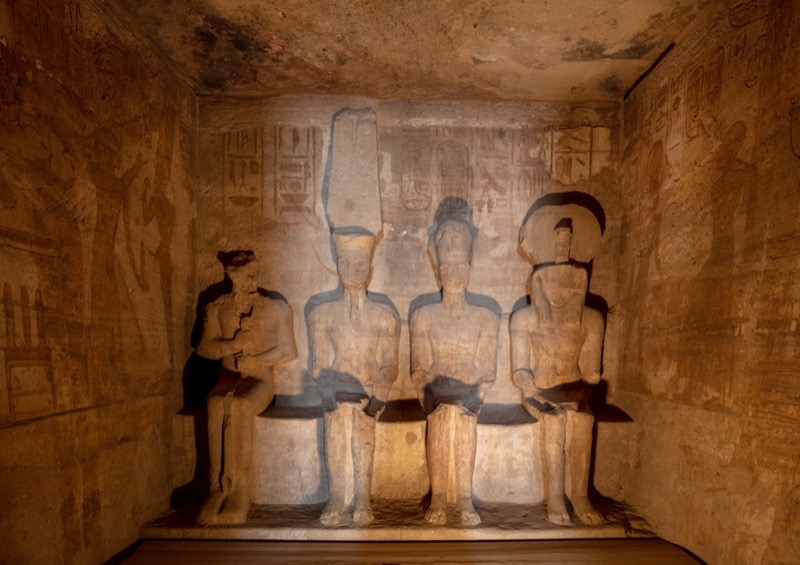
Abu Simbel Temples
The cliff temples of Abu Simbel, commissioned by Ramesses II around 1264 BCE, represent one of the most ambitious acts of royal self-projection in the ancient world. The Great Temple's four 21-metre seated colossi of Ramesses — carved from the cliff face rather than assembled from blocks — were accompanied by smaller standing figures of royal family members between their legs, encoding the hierarchy of the royal household in stone. The interior consists of a columned hall, a second hall, a vestibule, and the innermost sanctuary where four seated statues of Ptah, Amun-Re, Ramesses-deified, and Re-Horakhty receive the solar alignment twice yearly.
The relocation of the entire complex between 1964 and 1968 — cut into 2,000 blocks and reassembled on an artificial hill 65 metres higher — is one of the most technically complex engineering projects of the 20th century. Inside the artificial hill, a dome of concrete distributes the load of the reconstructed cliff above. The joins between the reassembled blocks are visible at close range on the exterior; inside, the spatial experience of the original is faithfully reproduced. The solar alignment on 22 February and 22 October functions as originally designed. Ticket: EGP 540. Day trip or overnight from Aswan by flight or road; see Nile Cruises guide for combined itinerary options.
Edfu · Upper Egypt
Temple of Horus at Edfu
The Temple of Horus at Edfu is the best-preserved ancient Egyptian temple in existence — not because it is the oldest, but because it was buried under the accumulating settlement of the town above it until its excavation in the 19th century. Construction was completed under Ptolemy III in 237 BCE and continued in phases for 180 years; the relief programme provides one of the most complete records of Egyptian temple cosmology and ritual procedure, explicitly noting the intended purpose of each relief scene in accompanying texts.
The temple's sanctuary still contains the granite naos — the shrine that housed the cult statue — intact and in its original position, something that has survived at very few other sites. The falcon heads of Horus flanking the pylon entrance are among the best-preserved monumental bird sculptures from antiquity. Edfu is a standard port of call on the Luxor–Aswan cruise route; independent visitors arrive by road from Luxor (50 km south) or Aswan (100 km north). Ticket: EGP 300. Best visited before or after the cruise ships dock (typically 09:00–13:00).
Luxor · West Bank
Medinet Habu — Temple of Ramesses III
Medinet Habu is one of the most undervisited major temple complexes in Egypt, despite covering nearly the same ground area as Karnak's Precinct of Amun-Re and preserving some of the finest coloured relief work surviving from the New Kingdom. The temple of Ramesses III, built between 1186 and 1155 BCE, is entered through a unique Syrian-style migdol gateway tower that served as a royal residence and viewing platform. The walls of the first and second courts carry the most detailed surviving record of the Sea Peoples invasions of circa 1175 BCE — a naval and land battle that shaped the eastern Mediterranean world and marked the end of the Bronze Age.
Interior colours in the hypostyle hall and second court retain extraordinary vibrancy in areas shielded from direct sunlight, particularly on the window grilles and column capitals. The temple also contains an intact royal palace attached to the southern side of the first court, with a window of appearances from which Ramesses III showed himself to assembled troops and officials — the only substantially preserved example of this architectural type. Medinet Habu is typically uncrowded even in peak season. Ticket: EGP 200. Combine with a visit to the nearby Colossi of Memnon and the Ramesseum. For the full West Bank picture, see our Luxor Guide.